Is Your Child Ready for First Grade? A First Grade Teacher Shares What Really Matters
Summer is such a special time for families. It’s filled with vacations, backyard cookouts, swimming pools, popsicles, late bedtimes, and making memories together. As a first grade teacher, I hope every child enjoys every minute of it!
But somewhere in the middle of summer, parents often begin asking the same question:
“Is my child ready for first grade?”
After teaching first grade for over ten years, and teaching all together for nearly 20 years, I’ve learned something that might surprise you.
It’s usually not the students who struggle the most that I worry about over the summer. Because those are the students that I get to keep another year. There were enough gaps that they weren’t developmentally ready to go to second.
Instead, I think about the students I just sent to second grade who still have a few learning gaps despite how hard we worked all year. They weren’t retained because they had learned enough to move on, but I know second grade moves quickly. Those missing foundational skills don’t simply disappear. Instead, they often become even more noticeable as the curriculum becomes more challenging.
And I imagine kindergarten teachers feel the same way. They send their students to first grade knowing they have learned so much, yet there may still be a few gaps that could make the transition to first grade more difficult. The good news is that summer provides a wonderful opportunity to strengthen those foundational skills before the first day of school.
The good news is that summer is the perfect time to strengthen those skills.
You don’t need expensive tutoring or hours of worksheets every day. Just 10 to 15 minutes of intentional practice a few days each week can make a tremendous difference.
Here are some skills that every child can benefit from before going to second grade.
Reading Skills Every Child Should Practice
Reading isn’t just one skill. It is made up of several important pieces that work together. When one area is weak, reading becomes more difficult. Here are the five areas I recommend practicing over the summer.
Phonics
What is it?
Phonics is understanding the relationship between letters and the sounds they make. Children use phonics to sound out unfamiliar words while reading.
By the end of first grade, students should be able to:
-
Read words with short and long vowels.
-
Read words with common vowel teams such as ai, ee, oa, and ay.
-
Read words with blends and digraphs.
-
Decode simple two-syllable words.
-
Read grade-level decodable text with confidence.
Try these activities:
-
Read decodable books together.
-
Build words with magnetic letters.
-
Change one sound to make a new word (cat → bat → bag → bug).
-
Sort words by spelling pattern.
Teacher Tip:
If your child gets stuck while reading, encourage them to “tap out” the sounds instead of guessing from the picture. Strong decoding skills build confident readers.
Phonemic Awareness
What is it?
Phonemic awareness is hearing and manipulating the sounds in spoken words without looking at print.
Practice skills such as:
-
Blending sounds together.
-
Breaking words into individual sounds.
-
Deleting sounds (Say “smile” without /s/.)
-
Substituting sounds (Change the /m/ in map to /t/.)
Easy activities:
-
Play sound games in the car.
-
Clap the sounds you hear.
-
Play “What’s my word?” by stretching sounds slowly.
No paper or pencils required!
Fluency
What is it?
Fluency means reading accurately, smoothly, and with expression.
Children should sound like they’re talking instead of reading one word at a time.
Fun practice ideas:
-
Read the same book several times.
-
Read to a stuffed animal.
-
Take turns reading pages.
-
Use funny character voices.
-
Perform a Reader’s Theater.
The goal is confidence—not speed.
Vocabulary
What is it?
Vocabulary is simply the number of words your child understands and can use correctly.
The larger a child’s vocabulary, the easier reading comprehension becomes.
Easy ways to build vocabulary:
-
Read aloud every day.
-
Stop and discuss interesting words.
-
Ask, “What do you think this word means?”
-
Play synonym and antonym games.
-
Talk during everyday activities like cooking or shopping.
Children learn new words best through conversation.
Comprehension
What is it?
Comprehension is understanding what is read.
A child may read every word correctly but still struggle to explain what happened.
Practice these skills:
-
Retell the beginning, middle, and end.
-
Predict what will happen next.
-
Discuss character feelings.
-
Ask questions while reading.
-
Make connections to real life.
One of the best questions you can ask is:
“What makes you think that?”
That simple question encourages deeper thinking.
Math Skills to Review Before Second Grade
Math builds on itself, just like reading. A strong foundation makes new learning much easier.
Addition Facts
Students should continue practicing simple addition facts until they become automatic.
Try:
-
Dice games
-
Card games
-
Flashcards
-
Dominoes
-
Online math games
Even practicing five minutes a day helps.
Base Ten Understanding
Children should understand that numbers are made up of tens and ones.
For example:
34 = 3 tens and 4 ones.
Use base ten blocks if you have them, or make your own using bundled straws, craft sticks, or drawings.
Practice:
-
Building numbers.
-
Comparing numbers.
-
Identifying tens and ones.
-
Counting by tens.
Understanding place value prepares students for larger numbers and addition.
Two-Digit Addition Without Regrouping
Students entering second grade should have experience adding two-digit numbers without regrouping.
Example:
23 + 15
Use base ten blocks or draw quick tens and ones to show the math before solving.
Hands-on practice helps children understand why the answer works instead of simply memorizing steps.
Shapes
Geometry is much more than recognizing pictures.
Children should know the names of common shapes along with their attributes.
Triangle
-
3 sides
-
3 corners (vertices)
Activity: Go on a triangle hunt around your house.
Square
-
4 equal sides
-
4 corners
Activity: Build one using craft sticks.
Rectangle
-
4 sides
-
Opposite sides are equal
Activity: Count rectangles during a walk or at the grocery store.
Rhombus
-
4 equal sides
-
Often looks like a diamond
Activity: Draw one and compare it to a square.
Hexagon
-
6 sides
-
6 corners
Activity: Look at pictures of honeycombs or soccer balls and find hexagons. But remember, hexagons are any 6 sided shape. It doesn’t have to be the honeycomb shape.
Don’t Forget the Skills That Aren’t on a Test
Some of the biggest predictors of success aren’t found in a workbook. All of these skills will help a child become confident and independent in 1st grade.
Independence
Encourage your child to:
-
Zip coats.
-
Open lunch containers. Open juice boxes. Put straws in juice boxes. Open fruit and pudding containers.
-
Pack a backpack.
-
Put away supplies.
-
Follow two- and three-step directions.
These skills help children feel confident from the very first day.
Handwriting
Continue practicing:
-
Correct pencil grip.
-
Letter formation.
-
Proper spacing.
-
Writing first and last name neatly.
Good handwriting allows children to focus on their ideas instead of forming letters.
Fine Motor Skills
Strengthen little hands by:
-
Coloring.
-
Cutting with scissors.
-
Building with blocks.
-
Playing with modeling dough.
-
Stringing beads.
Strong hands make writing easier.
Social and Emotional Skills
These skills are just as important as academics.
Practice:
-
Taking turns.
- Losing gracefully during games.
-
Sharing.
-
Listening while others speak.
-
Solving simple disagreements respectfully.
-
Trying again after making a mistake.
One of my favorite phrases to teach children is:
“I don’t know it…yet.” That tiny word reminds children that learning takes time.
Teacher Tip: Play simple board games as a family. Children learn far more than taking turns. They practice following directions, waiting patiently, handling disappointment, and celebrating someone else’s success. Those are all skills they’ll use in the classroom every day.
What I Wish Every Parent Knew
Parents often ask me,
“What should we work on this summer?”
My answer is always the same.
Children need intentional practice with the skills they’ll use in first grade.
A few minutes of reading.
A few math games.
Meaningful conversations.
Activities that review important concepts without making summer feel like school.
That’s where having the right resources can make all the difference. Instead of wondering what to practice next, you can simply open an activity and spend your time learning together.
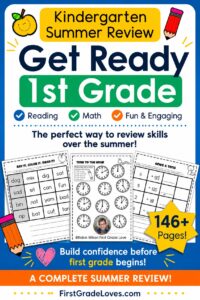
There isn’t just one way to prepare your child for first grade. The conversations you have, the books you read together, the games you play, and the everyday experiences you share all make a difference. If you’d like to add some structured practice to those everyday moments, I created this Get Ready for First Grade Summer Review to reinforce many of the foundational skills we’ve talked about throughout this article.
Remember, children don’t need to master every skill perfectly before the first day of school. They simply need a strong foundation and a love for learning.
I hope these ideas have given you practical ways to help your child get ready for first grade. If you’d like even more structured practice,
Here’s to a wonderful summer and an exciting start to first grade!
Want Even More Tips?
If you enjoy learning practical ways to help your child succeed, be sure to listen to The Education Connection Podcast.
In my episodes, I share classroom-tested strategies, literacy tips, and simple ways parents and teachers can help children become confident readers and learners.
📥 Free First Grade Readiness Checklist
Coming soon!! Want a simple checklist you can print and use this summer?
Download my FREE First Grade Readiness Checklist and make sure your child is ready for the first day of school.
👉 Get your free checklist here.